Screening Tests
1967 - 2007 manufactured by Adolf Kühner AG, Birsfelden, Switzerland
2008 - 2024 manufactured by TÜV-SÜD Schweiz AG, Basel, Switzerland
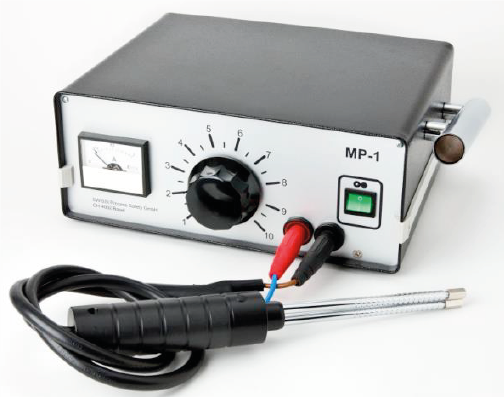
MP-1 - Burning Test
Determination of the flammability of a dry, powdery solid
→ at room temperature
→ at elevated temperature
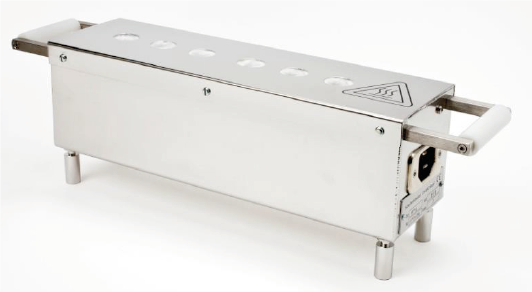
Lütolf-Ofen
Exothermic reaction in an open cup (Lütolf oven)
This test is designed to determine the lowest temperature at which a substance shows an exothermic reaction under defined oxygen-lean conditions.
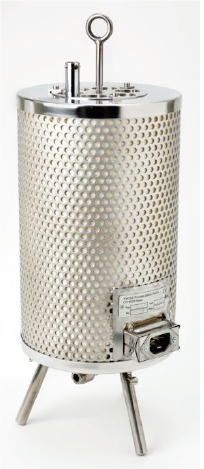
Grewer-Ofen
Testing for exotherm in the air flow
Determination of the lowest temperature at which a dry solid in a hot air flow (e.g. air dryer) exhibits exotherm.
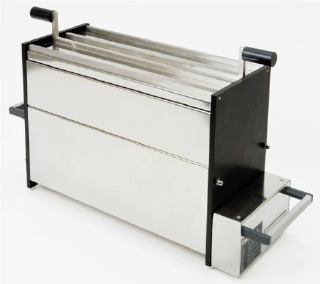
Mini-Autoklav
Testing for exotherm and pressure build-up in a closed vessel.
Tests are temperature-programmed and isoperibol, with and without additives.
The lowest temperature at which the substance to be tested shows an exothermic reaction is determined.
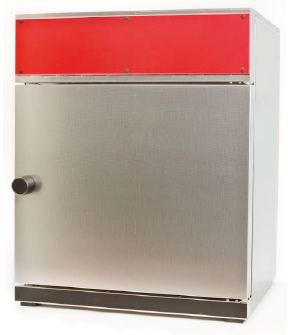
Hot Storage Testing
If powder products are exposed to a warm air atmosphere for a longer period of time, self-heating can occur due to exothermic processes, depending on the product, which can lead to ignition.
The hot storage test in the wire basket determines the lowest temperature in the isoperibolic test at which a dry solid in a warm air atmosphere just shows an exothermic heat tint.
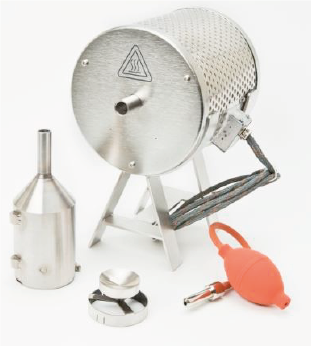
Ignition Test for Airborne Dust (BAM Oven)
Ignition test for whirled up dust
Determination of the lowest temperature (limit temperature) at which a substance can ignite when it comes into contact with whirled up dust.
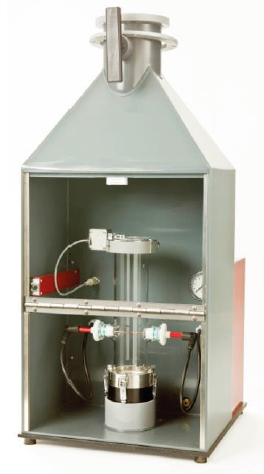
Modified Hartmann-Tube
The dust explosion behavior is tested in the modified Hartmann tube as a screening test.
The sample is whirled up in the modified Hartmann tube by a blast of compressed air.
At the same time, a high-voltage continuous spark gap is used to generate a stationary spark.

MP-3 Falling Hammer Test
Impact sensitivity test
→ of solids in accordance with Lütolf / ESCIS
→ of solids or liquids according to Koenen / BAM, OECD